New balloon-mounted probes have captured the strongest radiation spike at aviation altitudes in 20 years
Sandeep K S
Dec 5, 2025
1 min read
Solar Storm Alert: The most significant radiation increase since 2006 occurred due to an X5-class solar flare on November 11, 2025, causing radiation levels to soar to ten times the normal at 40,000 feet. This event triggered an estimated 60 electronic errors per hour in aircraft, prompting a rapid-response with balloon sensors gathering real-time data from 100,000 feet. For the first time, a 3D radiation image was developed, enhancing aviation safety forecasts by improving models against severe space weather.
What if a galaxy could exist without the brilliant stars that normally make galaxies visible? Cloud-9 may offer astronomers one of the most intriguing examples yet. Located near the spiral galaxy M94,
What if a galaxy could exist without the brilliant stars that normally make galaxies visible? Cloud-9 may offer astronomers one of the most intriguing examples yet. Located near the spiral galaxy M94, this mysterious hydrogen-rich object appears to contain enormous amounts of gas while producing almost no detectable starlight.
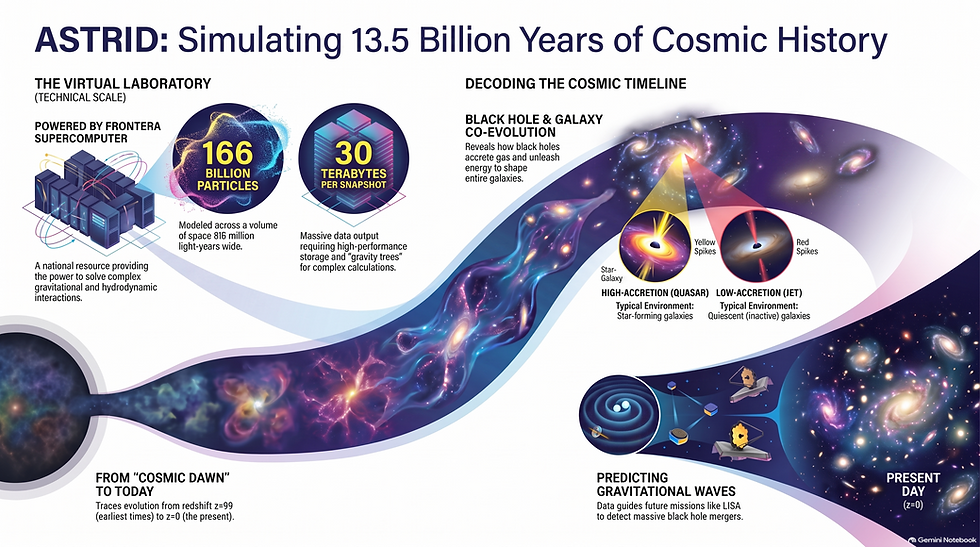
Astrophysicists have completed ASTRID, the largest cosmological hydrodynamic simulation ever run, tracing the universe from the cosmic dawn ($z=99$) down to the present day ($z=0$). By resolving 166 billion particles across 815 million light-years, ASTRID unveils how supermassive black holes co-evolve with galaxies and sculpt the cosmic web.
Scientists have uncovered the first robust evidence of a black hole and neutron star crashing together while orbiting in an oval path, challenging long-standing assumptions about cosmic pair formation.
Most neutron star-black hole pairs are expected to adopt circular orbits long before merging, their orbits slowly rounded out by the constant emission of gravitational waves over millions of years.






Comments