Can we find the chemical fingerprint of life in the light of a distant star?
Sandeep K S
Jan 13
1 min read
This infographic illustrates current and future efforts in searching for Earth-like planets through chemical "barcodes" in their atmospheres. It highlights new telescope missions such as ESA's Plato, NASA's Roman, and ESA's Ariel, which will help identify potential habitats by analyzing starlight patterns. Future endeavors include the Habitable Worlds Observatory (HWO), aiming to study 25 planets for signs of life, such as biosignatures and continental maps.
What if a galaxy could exist without the brilliant stars that normally make galaxies visible? Cloud-9 may offer astronomers one of the most intriguing examples yet. Located near the spiral galaxy M94,
What if a galaxy could exist without the brilliant stars that normally make galaxies visible? Cloud-9 may offer astronomers one of the most intriguing examples yet. Located near the spiral galaxy M94, this mysterious hydrogen-rich object appears to contain enormous amounts of gas while producing almost no detectable starlight.
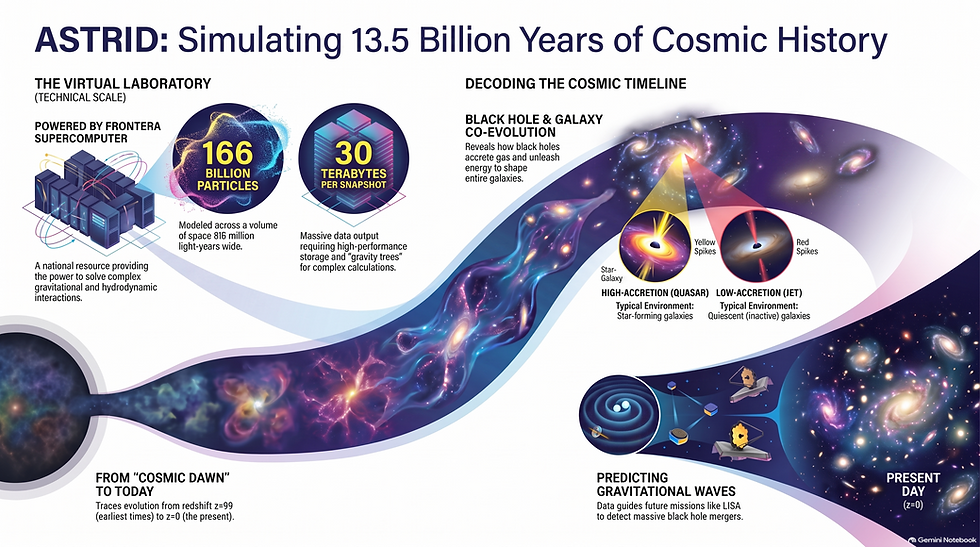
Astrophysicists have completed ASTRID, the largest cosmological hydrodynamic simulation ever run, tracing the universe from the cosmic dawn ($z=99$) down to the present day ($z=0$). By resolving 166 billion particles across 815 million light-years, ASTRID unveils how supermassive black holes co-evolve with galaxies and sculpt the cosmic web.
Scientists have uncovered the first robust evidence of a black hole and neutron star crashing together while orbiting in an oval path, challenging long-standing assumptions about cosmic pair formation.
Most neutron star-black hole pairs are expected to adopt circular orbits long before merging, their orbits slowly rounded out by the constant emission of gravitational waves over millions of years.






Comments