Astronomers have looked back in time to chart exactly how our galaxy evolved
Sandeep K S
Dec 21, 2025
1 min read
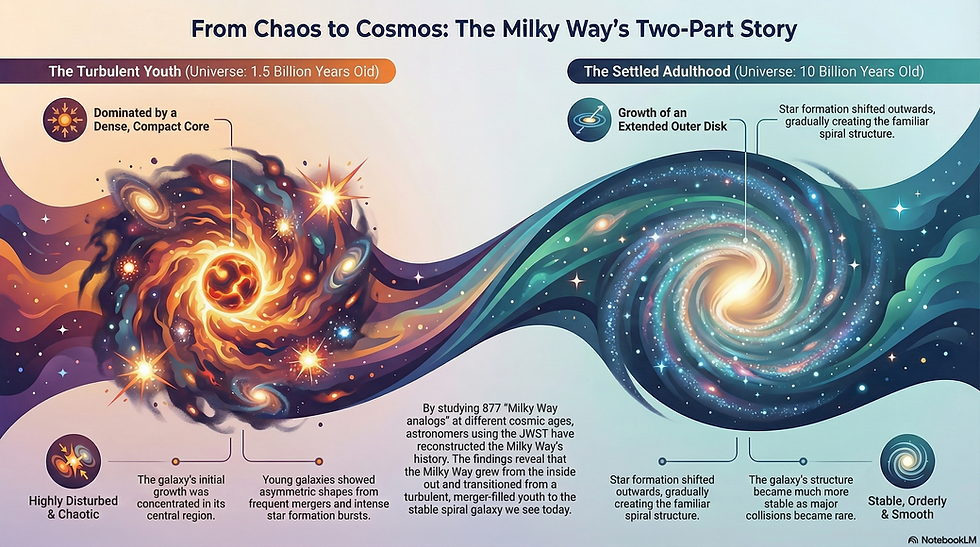
The transformation of the Milky Way from its chaotic, dense beginnings 1.5 billion years ago to a stable, spiral galaxy today is illustrated through its turbulent youth, dominated by frequent mergers and star formation, transitioning to a more orderly, structured adulthood with extended outer disks and fewer collisions.
Scientists have uncovered the first robust evidence of a black hole and neutron star crashing together while orbiting in an oval path, challenging long-standing assumptions about cosmic pair formation.
Most neutron star-black hole pairs are expected to adopt circular orbits long before merging, their orbits slowly rounded out by the constant emission of gravitational waves over millions of years.
Far from the warmth of any star, moons orbiting rogue gas giants might harbor oceans of liquid water—and potentially complex life—for billions of years.
Liquid water is considered essential for life. Surprisingly, however, stable conditions that are conducive to life could exist far from any sun.
Look up on a clear night and you'll see the streaks of our modern satellite networks. What you don't see is the growing fallout for the atmosphere that keeps us alive.
A wave of satellite launches and reentries is changing the chemistry and physics of the middle and upper atmosphere. Studies warn of ozone depletion, stratospheric heating, and new metal aerosols from burning spacecraft.





Comments