Astronomers Find a Black Hole Weighing 36 Billion Solar Masses
Sandeep K S
Aug 7, 2025
1 min read
Updated: Nov 11, 2025
The Cosmic Horseshoe galaxy is pictured, highlighting a newly discovered pair of images from a second background source. A faint central image forms near the black hole, aiding this significant discovery. Credit: NASA/ESA/Tian Li (University of Portsmouth).
What if a galaxy could exist without the brilliant stars that normally make galaxies visible? Cloud-9 may offer astronomers one of the most intriguing examples yet. Located near the spiral galaxy M94,
What if a galaxy could exist without the brilliant stars that normally make galaxies visible? Cloud-9 may offer astronomers one of the most intriguing examples yet. Located near the spiral galaxy M94, this mysterious hydrogen-rich object appears to contain enormous amounts of gas while producing almost no detectable starlight.
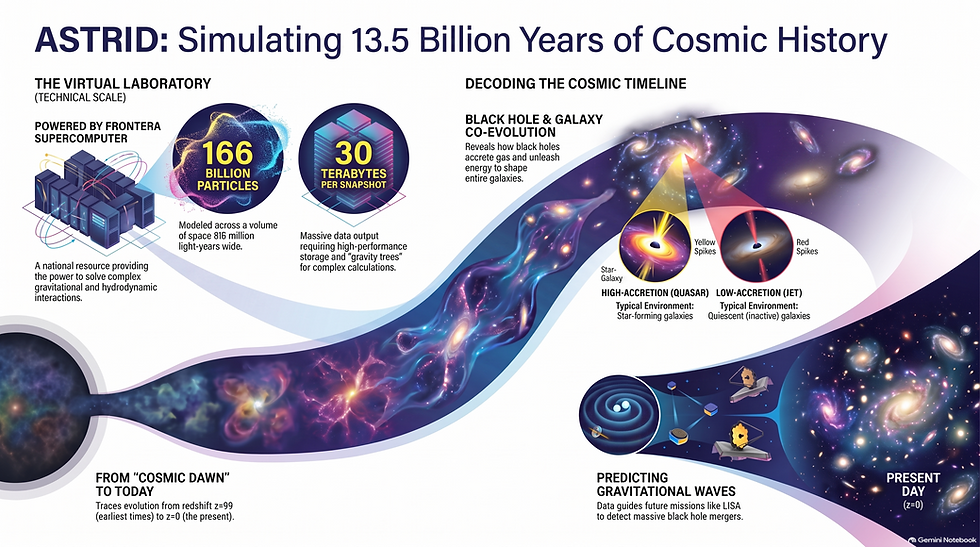
Astrophysicists have completed ASTRID, the largest cosmological hydrodynamic simulation ever run, tracing the universe from the cosmic dawn ($z=99$) down to the present day ($z=0$). By resolving 166 billion particles across 815 million light-years, ASTRID unveils how supermassive black holes co-evolve with galaxies and sculpt the cosmic web.
Scientists have uncovered the first robust evidence of a black hole and neutron star crashing together while orbiting in an oval path, challenging long-standing assumptions about cosmic pair formation.
Most neutron star-black hole pairs are expected to adopt circular orbits long before merging, their orbits slowly rounded out by the constant emission of gravitational waves over millions of years.






Comments